Showing posts with label West Boulevard Veterinary Clinic. Show all posts

Thursday, September 17, 2015

Annual Veterinary Exams & Preventive Health Care for Dogs

We all know that preventing disease or catching it in its early stages is far better than treating it once it has had time to progress to a more severe stage. Preventive health care on a regular basis will help you do just that, and save you and your pet from needless suffering and a larger financial burden. This article explains what preventive measures you can take to keep your dog healthy. 

ANNUAL PHYSICAL EXAM 
Just as annual physical exams are recommended for humans, they are recommended for our pets as well. If your dog is older or has medical problems, he may need even more frequent examinations. A year is a long time in a dog's life. Assuming our pets will live to their early teens, receiving a yearly exam means they will only have about thirteen exams in a lifetime. That is not very many when you think about it. 

 During your dog's annual physical exam you should review these aspects of your dog's health with your veterinarian: 
Vaccination status Parasite control for intestinal parasites, fleas, ticks, mites, and heartworms 
Dental health – care you give at home; any mouth odors, pain, or other signs of disease you may have observed 
Nutrition – including what your dog eats, how often, what supplements and treats are given, and changes in water consumption, weight, or appetite 
Exercise – how much exercise your dog receives including how often and what kind; and any changes in your dog's ability to exercise 
Ears and Eyes – any discharge, redness, or itching Stomach and intestines – any vomiting, diarrhea, constipation, gas, belching, or abnormal stools 
Breathing – any coughing, shortness of breath, sneezing, or nasal discharge 
Behavior – any behavior problems such as barking, 'accidents,' or changes in temperament 
Feet and legs – any limping, weakness, toenail problems 
Coat and skin – any hair loss, pigment changes, lumps, itchy spots, shedding, mats, oranal sac problems 
Urogenital – any discharges, heats, changes in mammary glands, urination difficulties or changes, neutering if it has not already been performed 
Blood tests – especially for geriatric dogs, those with medical problems, and those who are receiving medications 

VACCINATIONS 
 How often? 
You may have heard about the current controversies regarding vaccinating dogs and cats. Some researchers believe we do not need to vaccinate annually for most diseases. But how often we should vaccinate for each specific disease in adult animals has not yet been determined. We do not know how long the protection from a vaccine lasts. It may be 5 years for one disease and 3 years for another, and less than 2 years for another. Almost all researchers agree that for puppies we need to continue to give at least three combination vaccinations and repeat these at one year of age. They also agree that rabies vaccinations must continue to be given according to local ordinances. Against what diseases? Experts generally agree that the core vaccines for dogs include distemper,canine adenovirus-2 (hepatitis and respiratory disease), canine parvovirus-2, and rabies. Noncore vaccines include leptospirosis, coronavirus, canine parainfluenza andBordetella bronchiseptica (both are causes of 'kennel cough'), and Borrelia burgdorferi (causes Lyme Disease). Consult with your veterinarian to select the proper vaccines for your dog or puppy. Researchers at the Veterinary Schools at the University of Minnesota, Colorado State University, and University of Wisconsin suggest alternating vaccinations in dogs from year to year. Instead of using combination vaccines (vaccines against more than one disease), they recommend using vaccines with only one component, e.g., a vaccine that only contains parvovirus. So, one year your dog would be vaccinated against distemper, the next year against canine adenovirus-2, and the third year against parvovirus. Then the cycle would repeat itself. Other researchers believe we may not have enough information to recommend only vaccinating every 3 years. As with cat vaccines, manufacturers of dog vaccines have not changed their labeling which recommends annual vaccinations. Again, each dog owner must make an informed choice of when to vaccinate, and with what. Consult with your veterinarian to help you make the decision. For more information on vaccines, see Vaccines, Vaccination, and the Immune System of Dogs. 

 HEARTWORM TESTING 
When and how often pets should be tested for heartworm infection is also a matter of debate. In making a decision on when to test, we must consider how common heartworm disease is where the pet lives, what heartworm preventive the pet is receiving, and how long the mosquito season lasts. The American Heartworm Society (AHS) advises all adult dogs being started on a heartworm preventive for the first time should be tested. In addition, all dogs should be tested annually for heartworm infection. In the past, if a dog had been on preventive methods routinely, it was not considered necessary to test every year, perhaps only every two to three years. Because of reports of animals on preventives that still contracted heartworms, the AHS recommends a more conservative testing routine. It may be too difficult to document when an animal hasn't been checked in three years, and therefore, annual testing will ensure that an infection is caught in plenty of time to effectively manage it. 

 CONTROL OF INTESTINAL PARASITES 
As with vaccinations and heartworm testing, you will find different opinions on when or if fecal examinations should be performed and when or if pets should receive regular 'dewormings.' Decisions on testing and worming should be based on circumstances such as: the age of your dog the likelihood your dog is exposed to feces from other animals whether your dog is on a heartworm preventive that also controls intestinal parasites if your dog has been previously infected if you plan to breed your female dog if there are children who play with the dog Regular deworming is recommended by the American Association of Veterinary Parasitologists (AAVP), the Centers for Disease Control and Prevention (CDC), and the Companion Animal Parasite Council (CAPC). Puppies* Initiate treatment at 2 weeks; repeat at 4, 6, and 8 weeks of age, and then put on a monthly heartworm preventive that also controls intestinal parasites. Using a year-round heartworm preventive/intestinal parasite combination product decreases the risk of parasites. 

If not using such a product, worm at 2, 4, 6, and 8 weeks of age and then monthly until 6 months of age. Nursing Dams Treat at the same time as puppies. Adult Dogs If on a year-round heartworm preventive/intestinal parasite combination product, have a fecal test performed 1-2 times per year and treat appropriately. If not on a year-round heartworm preventive/intestinal parasite combination product, have a fecal test performed 2-4 times per year and treat appropriately. Also monitor and eliminate parasites in pet's environment. Newly Acquired Animals Worm immediately, after 2 weeks, and then follow above recommendations. * Drs. Foster and Smith suggest that owners of newly acquired puppies should obtain the deworming history of their new pet and contact their veterinarian to determine if additional deworming is needed. Roundworms and hookworms of dogs can cause serious disease in people, especially children who may not have good hygiene habits. Treating your dog for worms is important for your pet's health as well as your own. Many veterinarians would agree that at a minimum, dogs should have an annual fecal examination performed. Fecal examinations are advantageous. By having a fecal examination performed, you will know if your dog has intestinal parasites. If she does, you may need to change her environment and access to other animals. You will also know what type of parasites she has so the proper medication will be selected to kill all of them. 

GERIATRIC OR 'SENIOR' SCREENING 
Many veterinarians are starting to recommend screening tests for our older pets. Just as we have our cholesterol and blood pressure checked more often as we grow older, it is suggested our older pets need some routine checks too. Diabetes mellitus, kidney disease, and some hormonal diseases occur much more frequently in older animals. To test for these conditions and identify them before severe and/or irreversible damage is done, blood tests and sometimes radiographs are helpful. An abnormal result means we can diagnose and treat the condition early. Normal results are helpful in giving us a baseline with which we can compare future results. Many of our older animals are also on medications and may require tests to evaluate the medication level and/or potential harmful effects on various organs. Oral health is also extremely important in our older pets, so they may require more frequent dental check-ups. If you have an older dog, discuss these options with your veterinarian. In summary, annual exams along with recommended blood screening in older animals, vaccinations, heartworm testing, and parasite control will help your dog live a happier and longer life.


Monday, April 20, 2015

Senior Wellness

Did you know that a dog is considered a senior at just seven years old? It’s easy to forget that pets seven and older need extra special attention, when they still seem so young. 


We’re here to help you understand what to expect as your pet ages, so you can give your pet the best quality of life possible in their golden years.  

Senior evaluations and evaluations include diagnostics as required.

View the video below for more details about wellness exams.
http://wbvc.bc.ca/video-wellness-for-your-pet/

Tuesday, February 24, 2015

E-Cigarettes and Pets Do Not Mix


E-cigarettes are sparking heated debates as lawmakers, medical professionals and industry grapple over the relative safety of the nicotine-delivering devices. But for pet owners, there is no debate. Nicotine poses a serious threat of poisoning to dogs and cats, and e-cigarettes back a powerful punch. The problem is that many pet owners don’t realize it. 

Pet Poison Helpline has encountered a sharp uptick in calls concerning cases of nicotine poisoning in pets that ingested e-cigarettes or liquid nicotine refill solution. In fact, over the past six months, cases have more than doubled, indicating that along with their increased popularity, the nicotine-delivering devices are becoming a more significant threat to pets. While dogs account for the majority of cases, nicotine in e-cigarettes and liquid refill solution is toxic to cats as well. “We’ve handled cases for pets poisoned by eating traditional cigarettes or tobacco products containing nicotine for many years,” said Ahna Brutlag, DVM, MS, DABT, DABVT and associate director of veterinary services at Pet Poison Helpline. “But, as the use of e-cigarettes has become more widespread, our call volume for cases involving them has increased considerably.” In an effort to educate pet owners before an accident occurs, Pet Poison Helpline offers this important safety information. 

What are e-cigarettes? 
E-cigarettes are simply another way of delivering nicotine. Designed to resemble traditional cigarettes, the battery operated devices atomize liquid that contains nicotine, turning it into a vapor that can be inhaled. The most recent craze is flavored e-cigarettes, which are available in an array of flavors from peppermint to banana cream pie, and everything in between. 

What makes e-cigarettes toxic to pets? 
The aroma of liquid nicotine in e-cigarettes can be alluring to dogs, and flavored e-cigarettes could be even more enticing. The issue is the amount of nicotine in each cartridge, which is between 6 mg and 24 mg. So, each cartridge contains the nicotine equivalent of one to two traditional cigarettes, but purchase packs of five to 100 cartridges multiply that amount many times over, posing a serious threat to pets who chew them. For example, if a single cartridge is ingested by a 50-pound dog, clinical signs of poisoning are likely to occur. But if a dog that weighs 10 pounds ingests the same amount, death is possible. Dogs of any weight that ingest multiple e-cigarette cartridges are at risk for severe poisoning and even death. In addition to the toxicity of nicotine, the actual e-cigarette casing can result in oral injury when chewed, and can cause gastrointestinal upset with the risk of a foreign body obstruction. Some e-cigarette users buy vials of liquid nicotine solution for refilling e-cigarette cartridges. The solution is commonly referred to as “e-liquid” or “e-juice.” The small bottles hold enough liquid to fill multiple cartridges, meaning they contain a considerable amount of nicotine. Pet owners should be very careful to store them out of the reach of pets. 

What happens when e-cigarettes are ingested by pets?
Nicotine poisoning in pets has a rapid onset of symptoms – generally within 15 to 60 minutes following ingestion. Symptoms for dogs and cats include vomiting, diarrhea, agitation, elevations in heart rate and respiration rate, depression, tremors, ataxia, weakness, seizures, cyanosis, coma, and cardiac arrest. 

What to do if a pet is exposed? 
Because nicotine poisoning can happen so rapidly following ingestion, prompt veterinary care can mean the difference between life and death for a pet. Home care is not generally possible with nicotine exposure due to the severity of poisoning, even in small doses. Take action immediately by contacting a veterinarian or Pet Poison Helpline at 1-800-213-6680. As always, prevention is the best medicine. E-cigarettes, cartridges and vials of refilling solution should always be kept out of the reach of pets and children. 

SOURCE: http://www.petpoisonhelpline.com/2014/09/e-cigarettes-pets-mix/   Published on September 2, 2014


Tuesday, September 16, 2014

Why Dogs Bark and Growl

Does your dog growl or bark when a stranger approaches your house or when something goes bump in the night? If so, you’re not alone.


Most dogs will vocalize when they are exposed to new or different situations, including strange people or animals entering their territory; being separated from their pack, mother or even your family members; or new or alarming sounds. Dogs may also bark or growl when they see prey, such as squirrels, and they may bark for attention, food or if they are anxious. Dogs often growl when they are fearful or trying to assert themselves in a situation. If the dog’s fear or assertiveness is alleviated by growling or barking, the dog will learn that his behavior is acceptable and the behavior may become more frequent or severe. Some medical problems may cause growling or barking and older pets experiencing senile changes may have barking problems. Intense and continuous barking may be considered compulsive. Check with your veterinarian to evaluate your pet’s barking or growling problem. Behavior training and drug therapy may be helpful in reducing barking for pets with medical, geriatric and compulsive disorders.
Socializing your puppy can help
Acclimate your puppy to a variety of different people, environments, situations and noises to help lessen anxiety as your puppy grows. Make sure your puppy spends time alone so that he doesn’t develop separation anxiety while you are away from him. Proper training is essential to preventing behavior problems, such as growling and barking. Ask you veterinarian for more information about puppy training. 
Correcting a barking or growling problem
Correcting a barking or growling problem first requires that you have effective management of your dog. Once you have achieved this, you can begin to train your dog to lessen his barking or growling behavior by using rewards for quiet behavior. The reward should be something that the dog really likes such as a favorite treat, tummy rubs, or a favorite toy. Punishment is generally ineffective in correcting barking problems. Too much punishment may even exacerbate the behavior and cause the dog to be fearful or aggressive.
Begin your training with situations that you can easily control (such as a family member making a noise that causes the dog to bark) before moving on to difficult situations (such as a strange animal in your yard). When your dog barks at the stimuli (for instance, a doorbell ring), immediately interrupt the barking. When the dog is quiet offer the dog a reward for their behavior. Without the reward there is no incentive to remain quiet.Reward your dog when, at your request, he has stopped barking. Only reward the dog when he is quiet and gradually increase the amount of time that the dog needs to be quiet for him to receive a reward.
As the barking or growling problem decreases, make sure to direct your dog to more appropriate behavior, such as play, and the problem should lessen over time. Don't forget to discuss training options with your veterinarian to find the one that will work best for your pet.
Source: http://www.aaha.org/pet_owner/pet_health_library/dog_care/behavior/barking_and_growling.aspx

Thursday, July 24, 2014

Car Sickness In Pets

Does your dog throw up in the car when you go for rides? He may be experiencing typical motion sickness, just like some people do. Motion sickness usually begins very shortly after starting the car ride. The dog will begin to drool and then vomit. It’s not serious, but certainly not something that we like to clean up! To solve the problem, first try acclimating the dog to car rides. Do this by simply putting him in the car for a few minutes each day without going anywhere. Then try just going down the driveway and back, and the next day going around the block. Gradually build up the distance and time the dog rides in the car. 


 Sometimes this will help to decrease the dog’s anxiety over riding in the car and may help to decrease vomiting. If that doesn’t work, there are some over-the-counter medications you can try. The medication will need to be given about an hour before the car ride. Ask your veterinarian for a recommendation as to what drug to try and the dosage for your pet.

(Never give any medications to your pet without your veterinarian’s advice!) These drugs are safe, with drowsiness usually the only major side effect. But since your dog isn’t driving the car, that shouldn’t be a problem! If over-the-counter drugs don’t work, your veterinarian may be able to suggest another method for curing the car sickness.


Monday, May 19, 2014

Disaster Preparedness Tips

You may have heard about, if you were not part of, the natural disasters that have happened around the world.  One thing we know for sure is that hey can happen at any moment, so it is important to be well prepared. 


Emergencies come in many forms, and they may require anything from a brief absence from your home to permanent evacuation. Each type of disaster requires different measures to keep your pets safe. The best thing you can do for yourself and your pets is to be prepared.


Here are 3 easy steps that will help you get started on disaster preparedness.

Step 1: Get a Rescue Alert Sticker to let people know pets are inside your home. 
Step 2: Arrange a Safe Haven in the event of evacuation.
Step 3: Keep an Emergency Supplies and Traveling Kits handy and make sure everyone in your home knows where it is kept. 


Thursday, April 11, 2013

Can Cats and Houseplants Just Get Along?


West Boulevard Veterinary Clinic Cares For Your Cat

The team at West Boulevard Veterinary Clinic is concerned about health and well-being of your pet and we're committed to providing the most detailed, up-to-date information to our clients. If you have any questions about your pet's care, please contact us and we'll be happy to schedule an appointment with our team of qualified doctors. 

Cats and Houseplants 

If your houseplants are looking a little ragged or your cat shows symptoms of illness, interaction between them could be the cause. Houseplants may be good for the health of a home but can be dangerous for our feline friends. It is possible, however, to create a level of détente between them.

Although cats aren’t herbivores (their teeth aren’t designed for grinding plant matter), they do like plants as both toys and snacks. “I haven’t seen any consensus or definitive answer on why,” said Pam Johnson-Bennett, CCBC, owner of Cat Behavior Associates in Nashville, Tenn., who is a former veterinary technician and author of the recently released Think Like a Cat. “Chewing greenery may help with digestion, or something may be lacking in their diet. Boredom can do it; plants become something dangling and irresistible to bat and play with, and the next step is to chew on them.”

The problem is that “plants are either deadly or, at the very least, toxic to cats,” Johnson-Bennett said. “If they don’t kill your cat, at least it will experience intestinal disorders. Even the most basic houseplant, such as philodendron, is toxic, and toxicity can be extremely painful. Dieffenbachia can cause the cat’s tongue to swell, which affects breathing.”

Signs of Trouble

It’s fairly easy to tell if your cat has chewed on or swallowed a plant; the symptoms are vomiting, difficulty in breathing and lethargy. “If you see bits of plant matter in the vomitus or stool, there’s a good chance” the cat has snacked on your plants, according to Johnson-Bennett. Be sure you know the names of plants in your house, because knowing what plant your cat has eaten can affect treatment; inducing vomiting is sometimes the right move, but that can sometimes make matters worse.

If you notice these behaviors, call the veterinarian right away. “I don’t wait,” Johnson-Bennett said. “If I think my cat has ingested something poisonous, I am on the phone to the vet right away. Don’t have a wait-and-see attitude.”

The Association for the Prevention of Cruelty to Animals’ poison control center (aspca.org/Pet-care/poison-control/plant-list-cats.aspx) may be able to help, but nothing replaces getting to the vet right away.

Creating a Safe Harbor

A big believer that cats can be trained, Johnson-Bennett said that cats can be discouraged from eating houseplants if you apply bitter antichew spray made specifically for plants to the tops and bottoms of leaves. “You have to use it a couple of times at first, and reapply it on occasion.” (Be sure to wear gloves and a mask when using such a spray, and to wash your hands immediately after using it.)

Give cats a safe alternative that fulfills their apparent need for greenery; grass is the best bet. “You can grow cat grass in a place away from your plants; there are kits at pet stores and organic food stores. Wheat grass is very safe,” Johnson-Bennett noted. This may cause vomiting as well in some cats as a natural reaction when eating grass.

The best way to encourage cats to leave plants alone is to make sure they have enough play time, activities and toys to distract them from the plants, she said.

By the way, cats aren’t the only animals to pose a threat to houseplants; dogs may also nibble on houseplants when bored or lonely. “Dogs are chewers, so that problem can be solved by providing chew toys—something that is self-soothing, encourages comfort behavior and reduces separation anxiety,” Johnson-Bennett said.

Even better than training your cat to stay away from your plants is to “train the plants”:
  • Trim the trailing leaves and fronds of plants in hanging baskets to keep them out of reach.
  • Move plants away from areas where your cat likes to play or relax, and out of the path to the litter box.
  • Put garden netting or double-sided tape in planters in a criss-cross pattern to keep cats out.
  • Put large (too big for the cat to swallow and too heavy to move easily) river stones on top of dirt so that potting dirt isn’t easily accessible, which is both effective and decorative.
RESOURCES

This article originally appeared in PetsMatter March / April 2012, published by the American Animal Hospital Association. Copyright © 2012 AAHA.

Friday, March 15, 2013

Traveling by Car With Your Pet

The team at West Boulevard Veterinary Clinic knows that your pet is part of your family, and you're going to take them with you when you travel! We recommend a few travel safety tips for hitting the road with your pet in the article below, but please always check with us about specific travel needs that we recommend for your individual pet. 


Traveling by Car With Your Pet

Traveling with a pet usually involves more than putting the animal in a car and driving off, especially if you will be driving long distances or be away for a long time. The American Animal Hospital Association (AAHA) offers these tips to help you prepare for a car trip with your pet and make it go a little smoother.

If your pet is not accustomed to the car, take it for a few short rides before the trip. This can help keep your pet from becoming nervous or agitated, and may lessen the effects of motion sickness. If, after a number of practice trips, your pet continues to cry excessively or becomes sick, consult your veterinarian.


Buckling up is an important safety precaution for your pet. Many states now require that pets be restrained while in a moving vehicle, and restraints have several advantages. They help protect pets in case of a collision, and they keep pets from running loose and distracting the driver. They also keep pets from escaping the car through an open window or door. Cats and smaller dogs are often most comfortable in pet carriers, which can be purchased in various sizes at most pet stores.

Carriers give many animals a sense of security and familiar surroundings, and can be secured to the car seat with a seat belt or a specially designed carrier restraint. There are also pet restraints available that can be used without carriers, including harnesses, seat belt attachments, pet car seats, vehicle barriers, and truck/pickup restraint systems. No matter what kind of restraint you use, be sure that it does not permit your pet’s head to extend outside the car window. If pets ride with their heads outside the car, particles of dirt can penetrate the eyes, ears, and nose, causing injury or infections. Excessive amounts of cold air taken into lungs can also cause illness.

While packing for your trip, remember to throw in a few of your pet’s favorite toys, food and water bowls, a leash, and food. You should also carry a first aid kit for your pet, and know basic pet first aid. If your pet is on medication, be sure to have plenty for the trip -- and then some. Dr. Walt Ingwersen, AAHA veterinarian in Whitby, Ontario, points out that veterinarians cannot write a prescription without a prior doctor/patient relationship. This means that in order to get any drugs, your pet will need to be examined first by a new doctor. This may be inconvenient if you need medication right away. Also, if your pet is on a special therapeutic diet, bring along an extra supply in case you can’t find the food in a strange area.

Stick to your regular feeding routine while traveling, and give your pet its main meal at the end of the day or when you’ve reached your destination. It will be more convenient to feed dry food if your pet is used to it. Dispose of unused canned food unless it can be refrigerated. Take along a plastic jug of cold water to avoid possible stomach upset the first day, as new areas can have minerals or bacteria in their water supply that pets need time to adjust to. Give your pet small portions of both food and water and plan to stop every two hours for exercise.

Remember that your veterinarian is a good source of information about what your pet will need when traveling. Consider having your pet examined before you leave as well, to check for any developing problems. If an emergency occurs while you are on the road, you can call the American Animal Hospital Association at 800/883-6301 or visit our hospital locator for the names and phone numbers of AAHA veterinarians near you. Have your current veterinarian’s phone number handy in case of an emergency. Also, be sure to travel with a copy of your pet’s medical records, especially if the animal has a difficult medical history.

Some pets travel better while tranquilized. Tranquilizers can lessen agitation and motion sickness in pets traveling by car. Discuss this with your veterinarian. Your veterinarian may suggest giving your pet a tranquilizer three to four weeks before your trip to check the dosage and adjust it if necessary.
Find hotels, motels, and campsites that accept animals and book them ahead of time. "Vacationing with Your Pet" by Eileen Barish is a directory of pet-friendly lodging throughout the United States and Canada. Copies can be ordered by calling (800) 496-2665.

Learn more about the area you will be visiting. Your veterinarian can tell you if there are any diseases like
heartworm or Lyme disease and vaccinations or medications your pet may require. A health examination following your trip should be considered to determine if any internal parasites (roundworms, hookworms, heartworms) or external parasites (ticks, fleas) were picked up in contaminated exercise or wooded areas. Also, be aware of any unique laws. Some places have restrictions on exotic animals (ferrets are not allowed in some cities), and there are restrictive breed laws in others, such as no pit bulls allowed. Your pet could be affected by these laws, so call ahead to the city or travel information bureau for more information.

To avoid losing your pet during a trip, make sure your pet is wearing an i.d. tag. To be doubly protected, consider having your pet tattooed or having a microchip implanted. "The more methods of identification, the better chance that the owner will be found," says Dr. Ingwersen. Microchip databases are specific to the United States and Canada, so register your pet in both countries if you will be driving from one to the other. Dr. Ingwersen also suggests owners register the name and phone number of a relative who can identify the pet in case the owner can’t be reached while traveling.

It’s important to carry health and rabies vaccine certificates, particularly if you will be crossing the border into Canada, the US, or Mexico. All three countries allow dogs and cats to enter if they meet stringent entry requirements. Depending on the country, exotic pets may be allowed to enter, though they may need further documentation. Call the Agriculture Department or embassy of the country or state to which you are traveling for information on the vaccinations, documentation, fees, or quarantine that may be required to bring your pet into the country.

Most importantly, try to plan ahead for unusual or emergency situations. What you don’t need in the middle of a trip is one more thing to worry about. "People get into a panic if they don’t have enough medication for their pet, no appropriate documentation for travel to other countries, or money to pay for border fees," says Dr. Ingwersen. "Be prepared by bringing a copy of your pet’s medical records, proper documentation and medication and knowing the laws going into the new city or country." Preparation is the most effective way to help ensure a smooth, enjoyable trip for you and your pet.


Originally published by
Healthy Pet.

Monday, February 18, 2013

10 “People” Foods for Dogs


As a responsible and informed dog lover, you probably know that too much “people food” can make your dog ill or overweight, but there are some human foods that can be safely added to your dog’s meals in moderation to give a nutritional boost to Queenie’s diet and add a bit of variety to her food bowl. Just remember: any additions to your dog’s meals shouldn’t comprise more than 25 percent of her weekly caloric requirement.

1. Yogurt is a good source of available calcium and protein. When choosing yogurt, pick one that has live active bacteria and no sugars or artificial sweeteners. The active bacteria may act as probiotics. If your pooch is pudgy, make sure that you pick fat-free yogurt but not one that contains fat substitutes (e.g., Simplesse or Olestra). Frozen yogurt is a nice summer treat for dogs.

2. Flax seed (ground or oil) is a good source of omega-3 fatty acids, which are essential fatty acids that are good for skin and coat. Whole flax seeds are best if ground right before feeding as this type of fat can go rancid quickly. Flax seed can also be added to your dog’s diet as a source of fibre. Flax oil is a more concentrated form of omega- 3 fatty acids without the fibre. Make sure that you store the oil or seeds in the fridge in an air tight dark container.

3. Salmon is a fatty fish which is also a good source of omega- 3 fatty acids. These fats support the immune system and can be beneficial for skin and coat health. There has also been some indication that they may benefit dogs with allergies. You can feed salmon or salmon oil. If feeding salmon, make sure it’s cooked before serving, as raw salmon can carry a parasite that can make your dog sick.

4. Pumpkin is a good source of fibre and beta carotene (a source of vitamin A). Dogs need fibre in their diet. The current trend is towards highly digestible diets that lower stool volume and this is not necessarily a good thing. Keeping the GI tract moving helps keep the cells lining the gut healthy.

5. Sweet potatoes are another source of dietary fibre and contain vitamin B6, vitamin C, beta carotene, and manganese. Sweet potatoes are great sliced and dehydrated as a chewy treat for your dog. There are so many dog treats on the market that we often overlook the simple, healthy, and reasonably priced treats available at our grocery store.

6. Green beans are a good source of plant fibre, vitamin K, vitamin C, and manganese. If your dog has a tendency to put on weight, then replacing some of her regular food with green beans is a great low calorie way to fill her up and help her maintain a healthy weight. Many dogs enjoy green beans frozen.

7. Eggs are a great source of very digestible protein, riboflavin, and selenium. For some dogs that are prone to digestive upset, eggs can give them a little protein boost. Adding eggs to your dog’s food is a healthy treat. Make sure to use cooked whole egg, as raw egg whites can cause biotin deficiency. If you do a lot of training with your dog, consider taking cooked eggs to your next class as training treats.

8. Brewer’s yeast is the yeast that’s left over from making alcohol. Dogs seem to really enjoy the tangy taste of brewer’s yeast. It’s full of B vitamins which are good for skin, coat, and carbohydrate metabolism. Make sure you’re using brewer’s yeast (available at health food stores), not baking yeast which will make your dog sick. Brewer’s yeast can spice up your dog’s appetite. Just sprinkle a little on the food of a picky eater and watch her dive into her food.

9. Apples are wonderful crunchy treats for your dog. Apples with the skin on are full of plant chemicals (phytonutrients) that are thought to be protective against some types of cancer in humans. They are a source of vitamins A and C and fibre. Apple seeds, however, contain cyanide so your dog should not be allowed to eat the core. Though the effects of a few apple seeds will likely not harm your dog, the deleterious effects can accumulate over time if allowed to eat apple seeds regularly.

10. Oatmeal is a good source of soluble fibre. This can be beneficial for some older dogs that may have trouble maintaining bowel regularity. Oatmeal is also an alternative source of grain for dogs that are allergic to wheat. It can be fed in conjunction with probiotics to enhance their function. Keep in mind oatmeal should always be fed cooked and plain with no sugar or flavouring. As always, check with your veterinarian before making any major changes to your dog’s diet, especially if they are on any medications. Upsetting the vitamin and mineral balances in your dog’s diet can have negative effects on your dog’s health and some medications interact badly with some nutrients. The aim of most dog owners is to give their dogs the best diet possible. Good nutrition coupled with a health care program may result in extending your dog’s life by as much as 15 percent. The suggestions above are not meant to replace your dog’s normal, balanced diet. Rather, they are ideas for alternative treats or for adding a little variety to your dog’s meals.


Originally published in Modern Dog Magazine

Wednesday, November 28, 2012

Pumpkin Ice Bites for Dogs


Want to give your dog a safe and delicious holiday treat? Check out our blog for this great recipe that's so easy to make!


PUMPKIN ICE BITES FOR DOGS

Want your dog to have a delicious and safe holiday treat? Here's a simple recipe you can make at home:

Blend 1 cup of canned pumpkin with 1 cup of plain non-fat yogurt and freeze in an ice tray. Dogs can be given these one cube at a time (outside, because they can be a little messy for carpet!). 

This mixture can also be stuffed into a Kong or rubber stuffable toy and frozen. That will allow hours of dog entertainment!

Sunday, August 26, 2012

The Cat Run

What is this you say? Running cats ? Cats running from what? Is this an event?

No...nothing to do with cats running at all. It is about Kitty Lifestyles.

Many cats live their entire life indoors. That is the safest lifestyle for most cats...no cars, no attack dogs, no predators, no cat fight wounds. Very safe and often quite dull. Owners can liven up the lives of indoor cats by providing a stimulating environment. Cat beds on window ledges to view the great out doors, hiding small bits of food about the house to simulate hunting activity, walk ways around the house about 18" down from the ceiling with kitty doors allowing them to move from room to room. All these things are great but kitties do like to play the role of the great out door hunter, explore the wilds and lounge in sunbeams.

At WBVC most of our kitty patients live in a very urban area. Vancouver sports a huge population of urban wild life many of which consider cats the piece de resistance when it comes to gourmet dining. When they redesigned a local golf course they found in excess of 200 cat collars in one of the coyote dens!! In addition to coyotes there are many racoons and skunks...both of which can be a challenge for  out door cats.

Dr. Rurak and Ben have several cats in their home. Somehow cats manage to find them and then what is one to do? Invite them in of course. To increase the kitty square footage Ben built a network of cat walks throughout the house. As mentioned these are ledges that go along the walls close to the ceilings with cat door ways between rooms and resting places strategically spaced here and there. When you are in the home you don't realize they have several cats as the kitties have additional floor space! This was great but one of their kitties fondly called "Fish" has a tendency to run out the door whenever it is opened. He takes one on a grand tour before he comes back in again. He can't be left outside because the coyotes are lurking in the bushes waiting for a treat!

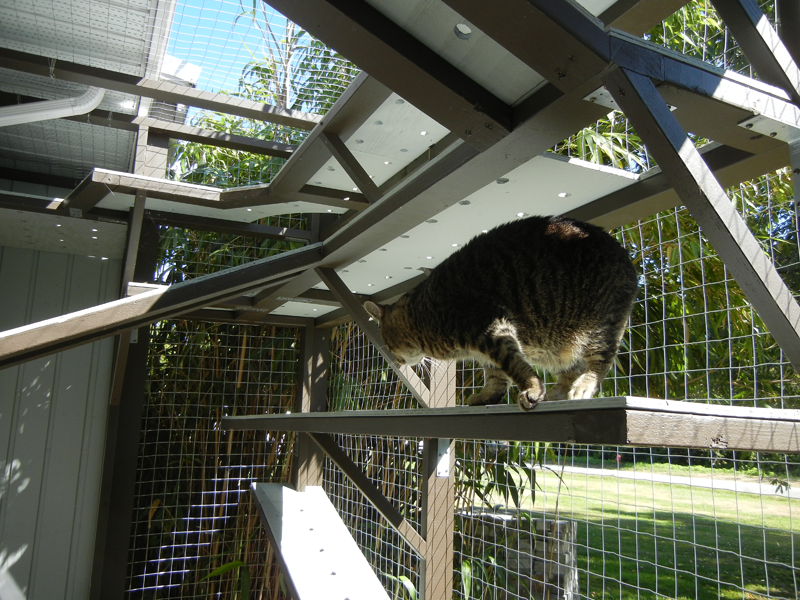
Dr Rurak had the solution. She and Ben would build an out door enclosure for the kitties. They would have access through a small window. The cat run, with various ledge levels to explore and lounge on, was a huge success!! The roof over hang provides shelter even on the rainiest days and there is plenty of space to sun bathe. Although rarely successful the kitties have the opportunity to hunt mice, frogs and birds that may be so foolish as to enter the enclosure.   An added advantage is that the cats much prefer the great out doors as a toilet so there is less mess in the indoor litter boxes!!

My kitties did not have a cat run:(  Their out door activities were restricted to highly supervised time on the patio and the occasional escape. The kitties loved the escapes but I did not! Seeing Ben 30 feet up a tree and Linus at 35 feet was not my idea of a good time.

The solution...Ben designed and built my cats the most wonderful cat run!! We put in a window that the kitties could go through but humans could not. The adjoining cat run sits partly obscured by a growth of bamboo. It is about 50/50 out in the open and under the eaves. It is a maze of cat walks, resting ledges and hidey holes. There is a brick area below the window to hopefully keep some of the dirt from coming into the house...I also placed a door mat under the window on the inside. There is a sand box toilet...which the kitties love.

Linus has been very brave...exploring all areas with gusto. Charles is a bit more cautious and hasn't made it to the top level. In time he will get there.

All that is left to do is the interior decoration. Cat beds on the resting places and a soft light for evening. I had the idea of a chandelier...to give an eclectic touch. However my sorte to the second time around store gave me a bit of sticker shock! I found just what I had envisioned...a small 1920s crystal chandelier..it was perfect. However there were some problems. First the proprietor was horrified that it would be going in a cat room (one strike against that shop). Second he said it would likely corrode if out doors and third...the final straw..it sported a $1200.00 price tag!!! Definitely beyond my budget so it is time to rethink the interior decor. Perhaps Ikea will have something that sparks my interest:)

For those of you that would love to have a cat run for your kitty but don't have a Ben to build it there are pre fab kitty runs available on line... from tiny cat ledges to cat walk mazes. ...just search "cat run" and several options pop up.

So to keep your kitties both safe and happy consider creating a cat run.

Here are photos of Charles and Linus's Super Run.

Tranquil kitty space

Blends in with the home 
Resting ledges..note the detail of drainage / ventilation holes

Bamboo seclusion. Wire is buried deep into the foundation.

Many levels

Open to the sky

Afternoon shade

Linus peeking at Charles

Linus and Charles

So much to explore!

Linus

Charles
                                                              THANK YOU BEN