Friday, September 14, 2012

The Health Benefits of Having Pets in Your Family


According to the American Pet Products Association 2010 Industry Statistics and Trends, there are many health benefits to pet ownership. I believe that this list is just the beginning of a very long list. What other health benefits have you found from having pets in your family?
  • Pets Help to Lower Blood Pressure A recent study at the State University of New York at Buffalo found that people with hypertension who adopted a cat or dog had lower blood pressure readings in stressful situations than did those who did not own a pet. (Dr. Karen Allen, State University of New York at Buffalo)
  • Pets Help to Reduce Stress Walking with a pet helps to sooth nerves and offers instant relaxation. Studies conducted worldwide have shown that the impact of a stressful situation is lesser on pet owners, especially males, than on those who do not own a pet. (Josephine M. Wills, Waltham Centre for Pet Nutrition, United Kingdom)
  • Pets Help to Prevent Heart Disease Because pets provide people with faithful companionship, research shows they may also provide their owners with greater psychological stability, thus a measure of protection from heart disease. (National Institute of Health Technology Assessment Workshop: Health Benefits of Pets)
  • Pets Help to Lower Health Care Costs People with pets actually make fewer doctor visits, especially for non-serious medical conditions. (National Institute of Health Technology Assessment Workshop: Health Benefits of Pets)
  • Pets Help to Fight Depression Pets help fight depression and loneliness, promoting an interest in life. When seniors face adversity or trauma, affection from pets takes on great meaning. Their bonding behavior can foster a sense of security. (Between Pets and People: The Importance of Animal Companionship)

Article originally published at Peternity.

Tuesday, September 11, 2012

Is your pet middle aged and/or stiff?? Read on...

There are many veterinary prescription diets available to help manage a wide range of medical issues and to maximally support general wellness of your pet.

Currently Hill's is offering a great promotion on Hill's J/D mobility diet. This diet is designed for pets that have clinical joint stiffness and/or are larger and middle aged (high risk for developing joint problems). Feeding a well researched balanced diet with optimal supplement levels is cheaper, not to mention easier, than feeding a basic diet and a separate supplement.

J/D is well balanced maintenance food formulated with the following benefits:

  • High levels of omega-3 fatty acids which can help reduce the degradation of cartilage, are proven to reduce discomfort and help to reduce the dose of painkillers
  • L-carnitine which helps maintain a healthy weight which in itself lowers stress on joints
J/D has been clinically proven to help your dog walk, run and jump better in as little as 21 days. The cat trials have a 28 day test period.

This is how the promotion works:
  • Your dog or cat must be assessed by a veterinarian as having some stage of arthritic joint disease
  • The first 5 pets switching from another diet will be provided with a FREE BAG of Hill's Prescription Diet j/d Mobility pet food. The bag size is determined by the size of the pet.
  • A "Before" score card ( 6 client and 5 veterinarian questions) must be completed before starting the trial
  • A reassessment appointment is done 21 days (28 days for felines) after starting the trial and an "After" score card is completed
  • A comparison is made between the "Before" and "After" scores
  • The veterinarian sends the results into Hill's Prescription Diets
  • The client receives the value of $25 in coupons to be applied to the next bags of Hill's Diet j/d Mobility pet food.
If you think your pet is eligible for this great offer please give us a call (604-266-7421) to start maximizing mobility through excellent nutrition.

Drs Potter & Rurak and Mandy Isaacs have travelled to Topeka Kansas to see first hand the Hill's nutrition research centre and the manufacturing plant. All of Hill's research tests must be non invasive in nature. The animals live happily in family groups under conditions akin to living with a family. They receive state of the art veterinary care. One of the things that really impressed us was the cleanliness of both the research centre and manufacturing plant. It was also amazing that the protein in any food lot can be traced not only to the source farm but to the source animal! Each batch of food is quality tested before it leaves the plant! This dedication to nutrition and research is one of the reasons WBVC highly recommends feeding veterinary prescription diets to your pets. We realize that not all pets are the same and may make alternative recommendations on a case to case basis.


Monday, September 10, 2012

Top Cat Poisons

In 2011, the ASPCA alone fielded 166,000 calls about cases of pet poisoning. Many of these were caused by things in your home that are harmless to you, but potentially fatal to your pet. Some of the most dangerous cat poisons are foods and medications we take on a daily basis.

Depending on how a particular substance affects your cat’s body and how much was ingested or inhaled, pet poisoning symptoms can include gastrointestinal and neurological problems, cardiac and respiratory distress, coma, and even death.

According to the Pet Poison Hotline, the top five sources of cat poisoning in 2011 were:

1. Medications for people. Pets have a much greater sensitivity to many of the common over-the-counter and prescription medications that may be in your home.

Some of the medications that often poison cats include:

Non-steroidal anti-inflammatory medications, such as ibuprofen or naproxen. The most common cause of pet poisoning, these painkillers can cause ulcers in the stomach and intestines, and kidney damage.
Acetaminophen (Tylenol) is particularly toxic to cats, resulting in red blood cell damage. Just two extra-strength tablets may prove fatal to felines.
Antidepressants may cause vomiting and, in more serious instances, serotonin syndrome - a dangerous condition that raises temperature, heart rate, and blood pressure, and may cause seizures.
Methylphenidate, an attention deficit hyperactivity disorder (ADHD) drug, is a stimulant for pets, raising heart rate, blood pressure, and body temperature.

2. House plants. Cats are notorious for noshing on houseplants, and the habit isn’t just bad for your potted treasures. Many common, beautiful houseplants contain cat poisons that can cause serious harm, and even death. Some of the plants toxic to cats include:

Lilies. Ingesting even small amounts of Easter lilies and related plants can cause severe kidney failure in cats.
Azaleas and rhododendrons. These pretty flowering plants contain toxins that may result in vomiting, diarrhea, coma, and sometimes even death.
Tulips and daffodils. The bulbs of these plants, if ingested, may cause serious stomach problems, convulsions, and damage to the heart.
Sago palms. Eating just a few seeds may be enough to cause vomiting, seizures, and liver failure.

3. Insecticides. Products for your lawn and garden may be poisonous to animals that ingest them, perhaps by grooming themselves after walking or laying in a recently treated area.

4. Household cleaners. Just as cleaners like bleach can poison people, they are also a leading cause of pet poisoning, resulting in stomach and respiratory tract problems. Other common household products dangerous to cats include laundry detergent, kitchen and bath surface cleaners, carpet cleaners, and toilet bowl cleaners.

5. Glow sticks and jewelry. You went to a concert or a fireworks display and brought home a glow stick or glow necklace. Cats are attracted to them, but they contain a very bitter tasting liquid called dibutyl phthalate. While rarely deadly, just one bite into glow sticks can cause your cat to drool profusely.

Other common sources of poison to cats include:

Gum and candy that contain xylitol, a sugar substitute that harms cats and dogs.

Chocolate.

Onions, garlic, chives. These plant foods can irritate the stomach and damage red blood cells.

Rat and mouse poison. Rodenticides, if ingested, can cause severe symptoms and may be fatal.

Pet medications. Just as we can be sickened or killed by medications intended to help us, cases of pet poisoning by veterinary drugs are not uncommon. Some of the more commonly reported problem medications include painkillers and de-wormers.

Chemical hazards. Not surprisingly, chemicals contained in antifreeze and paint thinner, and chemicals for pools, can act as cat poisons. The symptoms they may produce include stomach upset, depression, and chemical burns.

Heavy metals. Lead, which can be found in paint, linoleum, and batteries, can be poisonous if eaten by your cat. If ingested, lead can cause gastrointestinal and neurological problems.


Originally published by WebMD for Pets.


Sunday, August 26, 2012

The Cat Run

What is this you say? Running cats ? Cats running from what? Is this an event?

No...nothing to do with cats running at all. It is about Kitty Lifestyles.

Many cats live their entire life indoors. That is the safest lifestyle for most cats...no cars, no attack dogs, no predators, no cat fight wounds. Very safe and often quite dull. Owners can liven up the lives of indoor cats by providing a stimulating environment. Cat beds on window ledges to view the great out doors, hiding small bits of food about the house to simulate hunting activity, walk ways around the house about 18" down from the ceiling with kitty doors allowing them to move from room to room. All these things are great but kitties do like to play the role of the great out door hunter, explore the wilds and lounge in sunbeams.

At WBVC most of our kitty patients live in a very urban area. Vancouver sports a huge population of urban wild life many of which consider cats the piece de resistance when it comes to gourmet dining. When they redesigned a local golf course they found in excess of 200 cat collars in one of the coyote dens!! In addition to coyotes there are many racoons and skunks...both of which can be a challenge for  out door cats.

Dr. Rurak and Ben have several cats in their home. Somehow cats manage to find them and then what is one to do? Invite them in of course. To increase the kitty square footage Ben built a network of cat walks throughout the house. As mentioned these are ledges that go along the walls close to the ceilings with cat door ways between rooms and resting places strategically spaced here and there. When you are in the home you don't realize they have several cats as the kitties have additional floor space! This was great but one of their kitties fondly called "Fish" has a tendency to run out the door whenever it is opened. He takes one on a grand tour before he comes back in again. He can't be left outside because the coyotes are lurking in the bushes waiting for a treat!

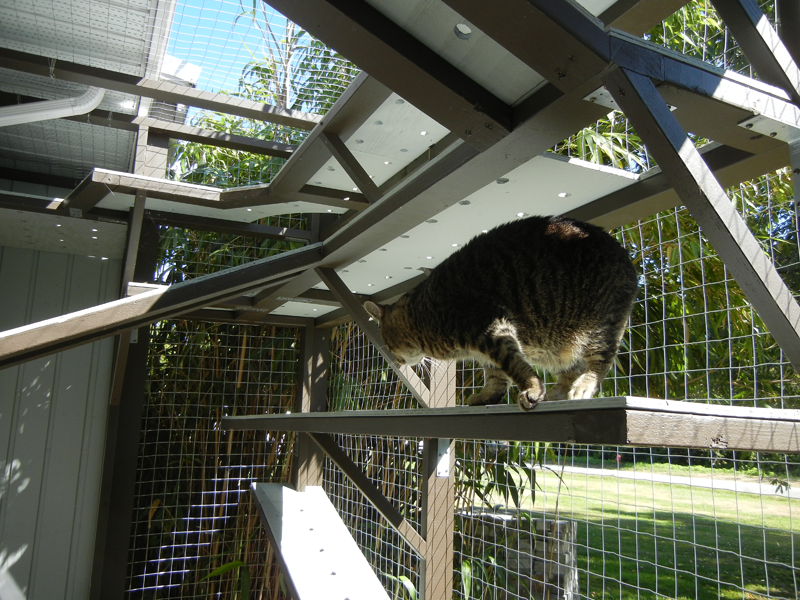
Dr Rurak had the solution. She and Ben would build an out door enclosure for the kitties. They would have access through a small window. The cat run, with various ledge levels to explore and lounge on, was a huge success!! The roof over hang provides shelter even on the rainiest days and there is plenty of space to sun bathe. Although rarely successful the kitties have the opportunity to hunt mice, frogs and birds that may be so foolish as to enter the enclosure.   An added advantage is that the cats much prefer the great out doors as a toilet so there is less mess in the indoor litter boxes!!

My kitties did not have a cat run:(  Their out door activities were restricted to highly supervised time on the patio and the occasional escape. The kitties loved the escapes but I did not! Seeing Ben 30 feet up a tree and Linus at 35 feet was not my idea of a good time.

The solution...Ben designed and built my cats the most wonderful cat run!! We put in a window that the kitties could go through but humans could not. The adjoining cat run sits partly obscured by a growth of bamboo. It is about 50/50 out in the open and under the eaves. It is a maze of cat walks, resting ledges and hidey holes. There is a brick area below the window to hopefully keep some of the dirt from coming into the house...I also placed a door mat under the window on the inside. There is a sand box toilet...which the kitties love.

Linus has been very brave...exploring all areas with gusto. Charles is a bit more cautious and hasn't made it to the top level. In time he will get there.

All that is left to do is the interior decoration. Cat beds on the resting places and a soft light for evening. I had the idea of a chandelier...to give an eclectic touch. However my sorte to the second time around store gave me a bit of sticker shock! I found just what I had envisioned...a small 1920s crystal chandelier..it was perfect. However there were some problems. First the proprietor was horrified that it would be going in a cat room (one strike against that shop). Second he said it would likely corrode if out doors and third...the final straw..it sported a $1200.00 price tag!!! Definitely beyond my budget so it is time to rethink the interior decor. Perhaps Ikea will have something that sparks my interest:)

For those of you that would love to have a cat run for your kitty but don't have a Ben to build it there are pre fab kitty runs available on line... from tiny cat ledges to cat walk mazes. ...just search "cat run" and several options pop up.

So to keep your kitties both safe and happy consider creating a cat run.

Here are photos of Charles and Linus's Super Run.

Tranquil kitty space

Blends in with the home 
Resting ledges..note the detail of drainage / ventilation holes

Bamboo seclusion. Wire is buried deep into the foundation.

Many levels

Open to the sky

Afternoon shade

Linus peeking at Charles

Linus and Charles

So much to explore!

Linus

Charles
                                                              THANK YOU BEN


Tuesday, August 7, 2012

Camping with your Dog

Summer is nearing its end, and lots of families are thinking about end-of-season camping trips before kids head back to school. Are you planning on taking your dog on a family camping trip? Remember that camping can be a great experience, as long as everyone is safe. Make sure your pet is up-to-date on flea and tick preventative before heading out to the woods. Also, be sure to bring plenty of dog food so that your dog doesn’t get tempted to eat your family’s picnic food. And lastly, make sure your campground of choice doesn’t have any pet restrictions posted because of the danger of large, predatory mammals in the area. Once you’re all ready for your camping trip, have a great time! 

Wednesday, July 25, 2012

Fun Summer Treat Recipes for Your Dog!

1
Combine 1/2 cup plain yogurt with 1/4 cup shredded carrots or chopped apples. Chop 4 ounces cooked liver, and add it to the yogurt mixture. Spoon the yogurt treats into an ice cube tray, and freeze.

2
Mix a can of chicken or tuna and two containers of plain yogurt. Add some cooked vegetables, if desired. Stir the mixture together, and put it in some small paper cups.

3
Make some quick-and-easy frozen dog yummies. Mix a cube of beef or chicken bouillon with 1 cup of warm water. Add several pieces of finely chopped leftover beef or chicken, and freeze the yummies until they're solid.

4
Create a frosty doggy treat with a jar of chicken or beef baby food. Add the baby food with 2 tablespoons of peanut butter and 2 tablespoons of honey. Mix well, and spoon the mixture into small paper cups or ice cube trays. Double the recipe for large dogs.

5
Chop a cup of peanuts, and stir them into a mashed banana for a fruit and protein treat. Add 1/4 cup wheat germ and 1/2 cup smooth peanut butter. Mix well and freeze.

Monday, May 14, 2012

Heartworm & Pets

Warm weather means the return of mosquitoes and the heartworm disease that they carry. Because a single bite from a mosquito could transmit the deadly heartworm parasite to your pet, it’s important that your pet stay on a heartworm preventative at all times. We can’t prevent the mosquitoes from biting, but we can prevent their harmful effects. We would love to discuss heartworm prevention for your pet!